Animal · Madagascar
Panther chameleon
Furcifer pardalis — the name this animal has in the language scientists everywhere share.
The panther chameleon is famous for its ability to change colour in flashes of red, orange, green and blue. It lives only in the forests of Madagascar, a large island off East Africa.
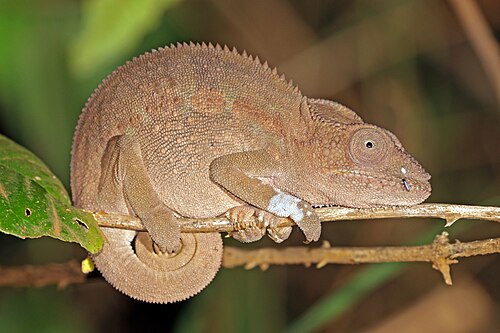
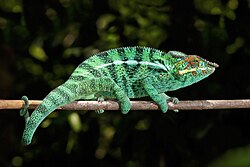
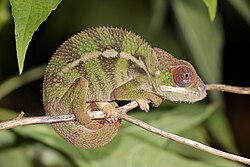
Picture credit: Charles J. Sharp (CC BY-SA 4.0) · Charles J. Sharp (CC BY-SA 4.0) · Charles J. Sharp (CC BY-SA 4.0) · Wikimedia Commons
Where does the panther chameleon live?
Home: Tropical forests of northern and eastern Madagascar.
In the wild you find it in: Madagascar.
Conservation status from the IUCN: not in danger.
The short profile
Fully grown it measures 40–51 cm long. It weighs about 0.15 kilograms. On the menu: insects.
The story behind it
A panther chameleon changes colour not to hide, but mainly to communicate, showing off bright colours to attract a mate, warn off rivals, or reflect its mood, using special crystal-like cells in its skin that reflect different wavelengths of light when the chameleon adjusts the spacing between them. Its eyes can move completely independently of each other, each scanning a different direction at once, giving it an almost 360-degree view, before both eyes lock onto prey together to judge distance. To catch insects, a panther chameleon fires its sticky tongue, which can be longer than its whole body, in under a twentieth of a second, one of the fastest movements in the animal kingdom. Colours also vary hugely depending on which part of Madagascar a chameleon comes from. Populations remain healthy across much of the island.
Find it on the globe
Panther chameleon is there as a tiny animated figure that breathes and looks around. From far away the planet is only a blue ball; detail arrives as you zoom in, and this one appears once you are close enough. Open it on the globe.
It sits at its real coordinates, not near them — the same numbers listed in the facts above. Switch off the layer for this kind of place and it disappears again; the buttons for that are down the right-hand edge.
Questions children ask
Why do chameleons change colour?
Chameleons mainly change colour to communicate rather than to hide. Bright colours can signal excitement, aggression toward a rival, or interest in a mate, produced by special crystal cells in the skin that reflect different light.
How fast is a chameleon's tongue?
A panther chameleon can shoot its tongue out and catch an insect in under a twentieth of a second, one of the fastest movements of any animal relative to its body size.
Can chameleons see in two directions at once?
Yes, a chameleon's eyes can move completely independently, letting it watch two different directions at the same time. When it spots prey, both eyes then swivel to focus together, helping it judge distance before striking.
Where these numbers come from
Every figure on this page was checked against public reference sources before publication. Where sources genuinely disagree, the text says so.
Last checked: