Animal · Australia, Indonesia, Philippines
Clownfish
Amphiprion ocellaris — the name this animal has in the language scientists everywhere share.
The clownfish is a small, bright orange reef fish famous for its unusual friendship with stinging sea anemones. It lives among coral reefs across the Indo-Pacific Ocean.
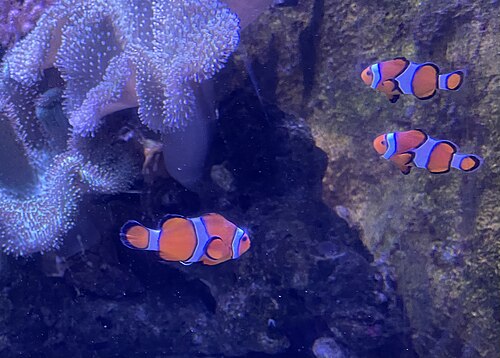
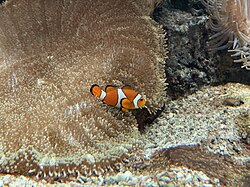
Picture credit: Pelagic (CC BY-SA 4.0) · Emilio J. Rodríguez Posada (CC BY-SA 2.0) · Amada44 (CC BY-SA 3.0) · Wikimedia Commons
Where does the clownfish live?
Home: Coral reefs of the Indo-Pacific Ocean.
In the wild you find it in: Australia, Indonesia, Philippines, Japan, Thailand.
Conservation status from the IUCN: not in danger.
The short profile
Fully grown it measures About 11 cm long. It weighs about 0 025 kilograms. On the menu: both plants and meat.
The story behind it
Clownfish live safely among the stinging tentacles of sea anemones, protected by a special mucus coating on their skin that stops the anemone's sting from harming them, while other fish that touch the anemone are stung. In exchange, the clownfish chases away anemone-eating fish and its droppings provide the anemone with nutrients, making the relationship beneficial for both. Every clownfish is born male, and each anemone is home to a small group led by one dominant, largest female; if she dies, the largest male in the group actually changes sex to take her place. Clownfish rarely stray more than a few metres from their home anemone their entire life, making them very territorial despite their small size. They remain common and are not currently considered at risk.
Find it on the globe
Clownfish is there as a tiny animated figure that breathes and looks around. From far away the planet is only a blue ball; detail arrives as you zoom in, and this one appears once you are close enough. Open it on the globe.
It sits at its real coordinates, not near them — the same numbers listed in the facts above. Switch off the layer for this kind of place and it disappears again; the buttons for that are down the right-hand edge.
Questions children ask
Why don't clownfish get stung by anemones?
Clownfish are coated in a special mucus layer that hides them from an anemone's sting, likely by mimicking the anemone's own chemical signals. Other fish without this protection are stung if they touch the same tentacles.
Can clownfish change sex?
Yes, every clownfish is born male, and each group living in one anemone is led by a single dominant female. If she dies, the largest male in the group changes sex and becomes the new female.
Do clownfish ever leave their anemone?
Rarely. Clownfish are highly territorial and usually spend their whole life within a few metres of a single host anemone, only venturing further during their brief larval stage before settling down.
Where these numbers come from
Every figure on this page was checked against public reference sources before publication. Where sources genuinely disagree, the text says so.
Last checked: