Animal · France, Spain, Kenya
Greater flamingo
Phoenicopterus roseus — the name this animal has in the language scientists everywhere share.
The greater flamingo is the largest flamingo species, wading through shallow salt lakes and lagoons on its long, thin legs. Its pink colour comes entirely from the tiny shrimp and algae it eats.
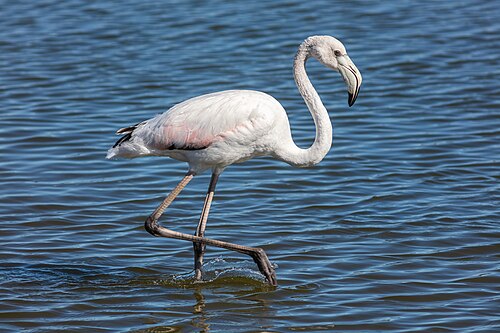
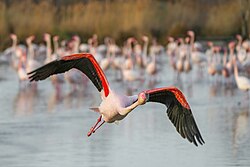
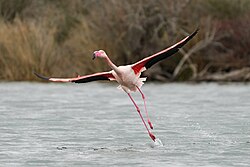
Picture credit: Diego Delso (CC BY-SA 4.0) · Giles Laurent (CC BY-SA 4.0) · Giles Laurent (CC BY-SA 4.0) · Wikimedia Commons
Where does the greater flamingo live?
Home: Shallow salt lakes and lagoons in Africa, Asia and Europe.
In the wild you find it in: France, Spain, Kenya, Tanzania, India.
Conservation status from the IUCN: not in danger.
The short profile
Fully grown it measures 1.1–1.5 m tall. It weighs about 3 kilograms. On the menu: tiny creatures it filters out of the water.
The story behind it
Flamingos feed with their heads upside down, sweeping their oddly bent beaks through the mud to filter out algae, tiny shrimp and other small creatures, much like a whale filters water for krill. The pigments in this food, called carotenoids, are what turn a flamingo's feathers pink; a flamingo fed on plain fish in a zoo would slowly fade to white. Flamingos live in huge colonies of thousands of birds and perform group courtship dances, marching and head-flagging together to choose a mate. Both parents feed their single chick a red liquid called crop milk. Though the species overall is doing well, many colonies rely on wetlands that are shrinking as water is diverted for farming.
Find it on the globe
Greater flamingo is there as a tiny animated figure that breathes and looks around. From far away the planet is only a blue ball; detail arrives as you zoom in, and this one appears once you are close enough. Open it on the globe.
It sits at its real coordinates, not near them — the same numbers listed in the facts above. Switch off the layer for this kind of place and it disappears again; the buttons for that are down the right-hand edge.
Questions children ask
Why are flamingos pink?
Flamingos are pink because of pigments called carotenoids in the algae and tiny shrimp they eat. A flamingo without this diet would gradually turn pale or white, which is why zoo flamingos are given special food to keep their colour.
Why do flamingos stand on one leg?
Standing on one leg helps flamingos keep warm by tucking the other leg, which loses heat fastest, close to their body. Their leg joints can lock in place, so balancing this way actually uses very little energy.
What do flamingos eat?
Flamingos filter-feed on algae, tiny shrimp and other small water creatures, sweeping their upside-down beaks through shallow mud and water. Their beaks contain comb-like structures that trap food while letting water flow back out.
Where these numbers come from
Every figure on this page was checked against public reference sources before publication. Where sources genuinely disagree, the text says so.
Last checked: