Animal · China
Giant panda
Ailuropoda melanoleuca — the name this animal has in the language scientists everywhere share.
The giant panda is a black-and-white bear that lives only in bamboo forests high in the mountains of China. Almost its entire diet is one single plant: bamboo.
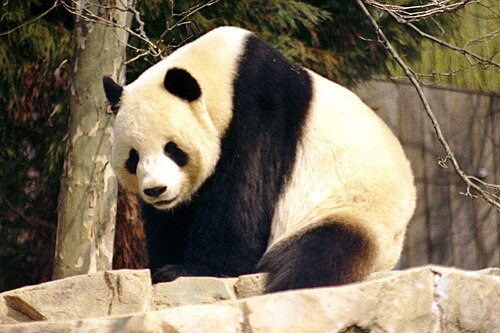
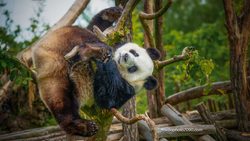
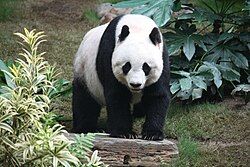
Picture credit: Jeff Kubina (Public domain) · Marian78ro (CC BY-SA 4.0) · J. Patrick Fischer (CC BY-SA 3.0) · Wikimedia Commons
Where does the giant panda live?
Home: Bamboo forests in the mountains of central China.
In the wild you find it in: China.
Conservation status from the IUCN: vulnerable.
The short profile
Fully grown it measures 1.2–1.9 m long. It weighs about 100 kilograms. On the menu: plants.
The story behind it
A panda spends up to 14 hours a day eating and can munch through around 12 kg of bamboo daily, because bamboo is so low in nutrients that it must eat huge amounts to get enough energy. Oddly, a panda's digestive system is built like a meat-eater's, not a plant-eater's, so it absorbs very little of what it swallows. Panda cubs are tiny and pink at birth, weighing about as much as a stick of butter. Thanks to decades of forest protection and breeding programmes in China, panda numbers have slowly recovered, and in 2016 the species moved from endangered to the less serious vulnerable category.
Find it on the globe
Giant panda is there as a tiny animated figure that breathes and looks around. From far away the planet is only a blue ball; detail arrives as you zoom in, and this one appears once you are close enough. Open it on the globe.
It sits at its real coordinates, not near them — the same numbers listed in the facts above. Switch off the layer for this kind of place and it disappears again; the buttons for that are down the right-hand edge.
Questions children ask
Why do pandas eat only bamboo?
Pandas mostly eat bamboo because it grows all year round in their mountain home, even though their bodies still digest meat better. Bamboo gives so little energy that a panda must eat huge amounts and move very little to save strength.
Are giant pandas still endangered?
Giant pandas are no longer classed as endangered but are still considered vulnerable. Conservation work in China has helped wild numbers grow, though the bears still depend on protected bamboo forests to survive.
How big is a baby panda?
A newborn panda cub weighs only about 100 grams, roughly the size of a stick of butter, even though its mother can weigh 100 kg. It is born pink, blind, and completely helpless for its first weeks.
Where these numbers come from
Every figure on this page was checked against public reference sources before publication. Where sources genuinely disagree, the text says so.
Last checked: