Animal · South Africa, Namibia, Botswana
Meerkat
Suricata suricatta — the name this animal has in the language scientists everywhere share.
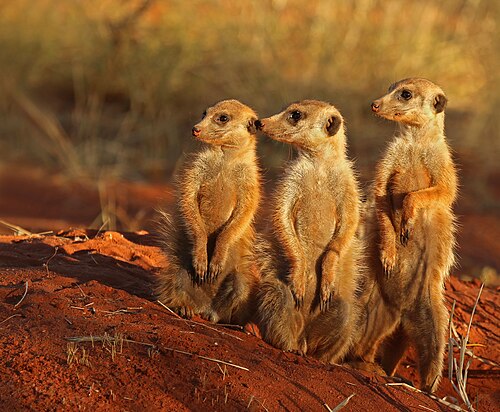
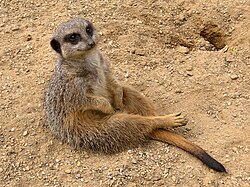
The meerkat is a small, sociable mongoose relative that lives in tight family groups in the dry grasslands of southern Africa. It is famous for standing tall on its hind legs to watch for danger.
Picture credit: Charles J. Sharp (CC BY-SA 4.0) · Hans Hillewaert (CC BY-SA 4.0) · Calistemon (CC BY-SA 4.0) · Wikimedia Commons
Where does the meerkat live?
Home: Dry grasslands and deserts of southern Africa.
In the wild you find it in: South Africa, Namibia, Botswana, Angola.
Conservation status from the IUCN: not in danger.
The short profile
Fully grown it measures up to 30 cm long, plus a 25 cm tail. It weighs about 0.7 kilograms. On the menu: both plants and meat.
The story behind it
Meerkats live in groups called mobs or gangs of up to 50 animals and take turns acting as a lookout, called sentry duty, standing tall on a mound while others dig for food. Dark patches around their eyes work like natural sunglasses, cutting glare from the sun so they can spot eagles and other predators from far away. They are largely immune to the venom of scorpions and snakes, which lets them safely hunt creatures that would be dangerous for most other animals. Pups learn to handle dangerous prey like scorpions by watching adults carefully remove the stinger first. Thanks to their teamwork and adaptability, meerkat populations remain healthy across their range.
Find it on the globe
Meerkat is there as a tiny animated figure that breathes and looks around. From far away the planet is only a blue ball; detail arrives as you zoom in, and this one appears once you are close enough. Open it on the globe.
It sits at its real coordinates, not near them — the same numbers listed in the facts above. Switch off the layer for this kind of place and it disappears again; the buttons for that are down the right-hand edge.
Questions children ask
Why do meerkats stand on their back legs?
Meerkats stand upright to act as lookouts, called sentries, scanning the sky and ground for eagles, jackals and snakes while the rest of the group forages. They take turns on watch and give sharp alarm calls if danger appears.
Are meerkats immune to scorpion stings?
Meerkats have a strong natural resistance to the venom of many scorpions and snakes, though they are not completely immune. This resistance lets them safely eat scorpions after biting off the dangerous stinger.
Do meerkats live in family groups?
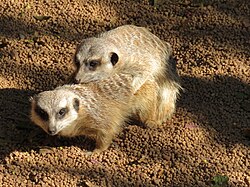
Yes, meerkats live in close family groups called mobs, often led by a dominant breeding pair, with all members helping to babysit pups, dig burrows and keep watch. This teamwork is key to their survival in a harsh desert.
Where these numbers come from
Every figure on this page was checked against public reference sources before publication. Where sources genuinely disagree, the text says so.
Last checked: