Animal · Indonesia, Thailand, Malaysia
Reticulated python
Malayopython reticulatus — the name this animal has in the language scientists everywhere share.
The reticulated python is the longest snake species in the world, with some individuals measured at over 6 metres. It lives in rainforests, grasslands and rivers across Southeast Asia.
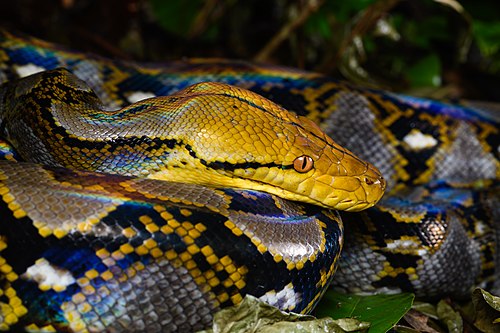
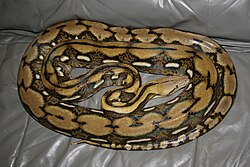
Picture credit: Rushenb (CC BY-SA 2.0) · BurmesePython (Public domain) · FakirNL (CC BY-SA 4.0) · Wikimedia Commons
Where does the reticulated python live?
Home: Rainforests and grasslands of Southeast Asia.
In the wild you find it in: Indonesia, Thailand, Malaysia, Philippines, Vietnam, Myanmar.
Conservation status from the IUCN: not in danger.
The short profile
Fully grown it measures 3–6 m long, occasionally longer. It weighs about 25 kilograms. On the menu: meat.
The story behind it
Reticulated pythons kill by constriction, wrapping their powerful body around prey and tightening their coils each time the animal breathes out, so it cannot draw another breath, rather than crushing bones as often shown in films. They can unhinge their elastic jaws to swallow prey much wider than their own head, including deer and, very rarely, humans, though such attacks are extremely uncommon. After a large meal, a python's metabolism speeds up dramatically, and its heart and internal organs can temporarily grow larger to help digest the meal, before shrinking back down once digestion is complete. Excellent swimmers, reticulated pythons are sometimes found far out at sea and have used ocean currents to reach remote islands. Though still widespread, they are heavily hunted for their skin and meat across parts of their range.
Find it on the globe
Reticulated python is there as a tiny animated figure that breathes and looks around. From far away the planet is only a blue ball; detail arrives as you zoom in, and this one appears once you are close enough. Open it on the globe.
It sits at its real coordinates, not near them — the same numbers listed in the facts above. Switch off the layer for this kind of place and it disappears again; the buttons for that are down the right-hand edge.
Questions children ask
How does a python kill its prey?
A reticulated python squeezes its coils tighter each time its prey breathes out, gradually preventing the animal from taking another breath, rather than crushing it. This method is called constriction.
Can a python's body change after eating?
Yes, after a large meal a python's heart and digestive organs can temporarily grow bigger and its metabolism speeds up dramatically to help digest the food, before shrinking back to normal size once the meal is processed.
Are reticulated pythons dangerous to people?
Reticulated pythons are large enough to occasionally pose a danger, but attacks on humans are extremely rare and usually involve very large individuals. They generally avoid people and prefer to hunt smaller, easier prey.
Where these numbers come from
Every figure on this page was checked against public reference sources before publication. Where sources genuinely disagree, the text says so.
Last checked: