Animal · South Africa, Namibia, Kenya
White rhinoceros
Ceratotherium simum — the name this animal has in the language scientists everywhere share.
The white rhinoceros is the largest of the five rhino species and the second-biggest land mammal after the elephant. It grazes on grass across the savannas of southern Africa.
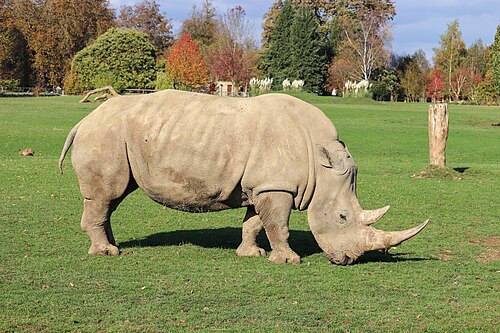
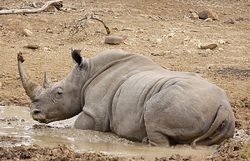
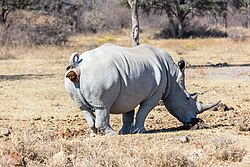
Picture credit: Vauxford (CC BY-SA 4.0) · Derek Keats (CC BY 2.0) · Diego Delso (CC BY-SA 4.0) · Wikimedia Commons
Where does the white rhinoceros live?
Home: Grasslands and savannas of southern and eastern Africa.
In the wild you find it in: South Africa, Namibia, Kenya, Zimbabwe, Uganda.
Conservation status from the IUCN: close to being at risk.
The short profile
Fully grown it measures up to 4 m long. It weighs about 2 100 kilograms. On the menu: plants.
The story behind it
Despite its name, the white rhino is actually grey; its name likely comes from a mistranslation of the Afrikaans word 'wyd', meaning wide, which describes its broad, square lips built for grazing grass. Its horn is made entirely of keratin, the same material as human fingernails and hair, yet it can grow back slowly if broken. White rhinos can weigh over 2,000 kg but can still trot at a surprising 40 km/h when alarmed. Poaching for their horns, wrongly believed by some to have medicinal power, has devastated rhino populations, though strong protection in parks has helped southern white rhino numbers recover somewhat.
Find it on the globe
White rhinoceros is there as a tiny animated figure that breathes and looks around. From far away the planet is only a blue ball; detail arrives as you zoom in, and this one appears once you are close enough. Open it on the globe.
It sits at its real coordinates, not near them — the same numbers listed in the facts above. Switch off the layer for this kind of place and it disappears again; the buttons for that are down the right-hand edge.
Questions children ask
Why is the white rhino called 'white' if it is grey?
The name likely comes from a mix-up of the Afrikaans word for 'wide', describing its broad square mouth, not its colour. Both white and black rhinos are actually the same shade of grey.
What is a rhino horn made of?
A rhino's horn is made entirely of keratin, the same protein found in human hair and fingernails, not bone or ivory. It grows continuously throughout the rhino's life.
Why are rhinos hunted?
Rhinos are illegally hunted, or poached, because some people wrongly believe their horns have healing powers, even though science shows they have no more effect than chewing fingernails. This poaching remains the biggest threat to rhinos.
Where these numbers come from
Every figure on this page was checked against public reference sources before publication. Where sources genuinely disagree, the text says so.
Last checked: