Animal · Russia, Germany, Finland
Eurasian lynx
Lynx lynx — the name this animal has in the language scientists everywhere share.
The Eurasian lynx is the largest wild cat in Europe, recognisable by its tufted ears, short tail and spotted coat. It hunts alone and silently through dense forests across Europe and Asia.
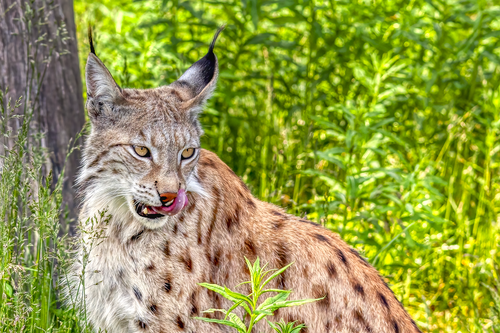


Picture credit: Jon Glittenberg (CC BY-SA 4.0) · Triplec85 (CC BY-SA 4.0) · Triplec85 (CC BY-SA 4.0) · Wikimedia Commons
Where does the eurasian lynx live?
Home: Forests across Europe and Asia.
In the wild you find it in: Russia, Germany, Finland, Sweden, Norway, Romania, Poland, Switzerland.
Conservation status from the IUCN: not in danger.
The short profile
Fully grown it measures up to 1.3 m long, plus a 20 cm tail. It weighs about 20 kilograms. On the menu: meat.
The story behind it
A lynx's black ear tufts are thought to help it hear even better, working almost like tiny antennas that pick up faint sounds, while its exceptional hearing lets it detect prey moving through snow from a great distance. Its large, wide paws act like natural snowshoes, spreading its weight so it can move silently across deep snow without sinking, an advantage over heavier prey like roe deer. Lynx are extremely secretive and solitary, marking huge forest territories that can stretch over several hundred square kilometres, so they are rarely seen even where common. Hunted heavily for fur in past centuries and eliminated from much of Western Europe, Eurasian lynx have been successfully reintroduced to several countries and their overall population is now considered stable and of least concern.
Find it on the globe
Eurasian lynx is there as a tiny animated figure that breathes and looks around. From far away the planet is only a blue ball; detail arrives as you zoom in, and this one appears once you are close enough. Open it on the globe.
It sits at its real coordinates, not near them — the same numbers listed in the facts above. Switch off the layer for this kind of place and it disappears again; the buttons for that are down the right-hand edge.
Questions children ask
Why does a lynx have tufted ears?
Scientists believe a lynx's black ear tufts may help enhance its already excellent hearing, working somewhat like tiny antennas. They may also help with communication between lynxes, though their exact purpose is still studied.
Are Eurasian lynx dangerous to humans?
Eurasian lynx are extremely shy and avoid people, with no recorded wild attacks on humans. They are solitary hunters that focus entirely on prey like deer and hares, far from human settlements whenever possible.
How were lynx brought back to Western Europe?
After being hunted to extinction in much of Western Europe, Eurasian lynx were reintroduced starting in the 1970s by releasing animals from stable Eastern European and Carpathian populations into forests in countries like Switzerland, France and Germany.
Where these numbers come from
Every figure on this page was checked against public reference sources before publication. Where sources genuinely disagree, the text says so.
Last checked: