Animal · United States, Canada, Mexico
Raccoon
Procyon lotor — the name this animal has in the language scientists everywhere share.
The raccoon is a clever, ring-tailed mammal easily recognised by the black mask across its eyes. Native to North America, it thrives in forests, wetlands and even busy cities.
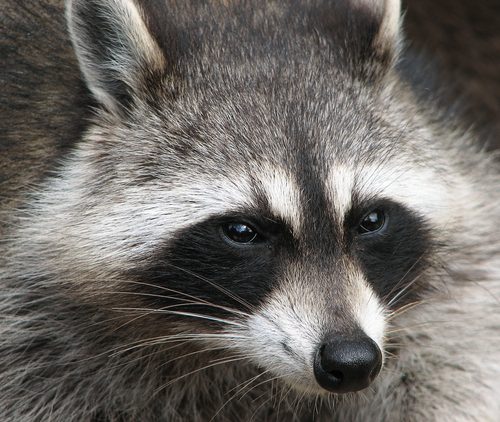
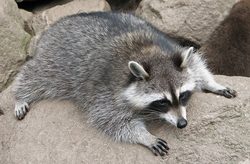
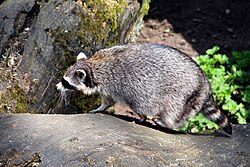
Picture credit: Darkone (CC BY-SA 2.5) · Darkone (CC BY-SA 2.5) · Jean-Pol GRANDMONT (CC BY 3.0) · Wikimedia Commons
Where does the raccoon live?
Home: Forests, wetlands and cities across North America and parts of Europe.
In the wild you find it in: United States, Canada, Mexico, Germany, France.
Conservation status from the IUCN: not in danger.
The short profile
Fully grown it measures up to 70 cm long, plus a 25 cm tail. It weighs about 7 kilograms. On the menu: both plants and meat.
The story behind it
A raccoon's front paws are extremely sensitive, with far more nerve endings than most mammals, so touch is almost as important to it as sight, especially in the dark or underwater where it often searches for food. This is likely why raccoons appear to 'wash' their food in water, actually feeling and softening it rather than truly cleaning it. Raccoons are excellent problem solvers, able to open latches, jars and even some door handles to find food. Introduced to parts of Europe and Japan through the pet trade, raccoons have become successful, sometimes unwelcome, invaders far from their native range. Their adaptability keeps wild populations thriving nearly everywhere they live.
Find it on the globe
Raccoon is there as a tiny animated figure that breathes and looks around. From far away the planet is only a blue ball; detail arrives as you zoom in, and this one appears once you are close enough. Open it on the globe.
It sits at its real coordinates, not near them — the same numbers listed in the facts above. Switch off the layer for this kind of place and it disappears again; the buttons for that are down the right-hand edge.
Questions children ask
Why do raccoons wash their food?
Raccoons appear to wash food because wetting their extremely sensitive front paws helps them feel and soften the food to identify what it is, not because they are actually cleaning it. This behaviour is more common in captivity than in the wild.
Are raccoons smart?
Yes, raccoons are considered one of the most intelligent mammals, capable of solving complex puzzles, opening latches, and remembering solutions for years. Their clever paws and curiosity help them find food almost anywhere.
Do raccoons live in Europe?
Yes, raccoons were brought to Europe, especially Germany, in the 20th century for fur farming and as pets, and escaped animals have since built large wild populations. They are considered an invasive species there today.
Where these numbers come from
Every figure on this page was checked against public reference sources before publication. Where sources genuinely disagree, the text says so.
Last checked: