Animal · Poland, Germany, United Kingdom
Red squirrel
Sciurus vulgaris — the name this animal has in the language scientists everywhere share.
The red squirrel is a small, agile tree-dweller found in forests across Europe and Asia, known for its bushy tail and ear tufts. It is a busy hoarder, storing food for winter.
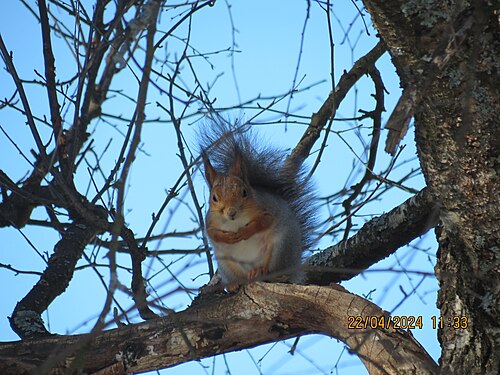
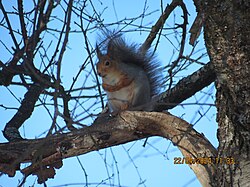
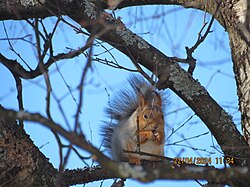
Picture credit: Sniiiif (CC BY-SA 4.0) · Sniiiif (CC BY-SA 4.0) · Sniiiif (CC BY-SA 4.0) · Wikimedia Commons
Where does the red squirrel live?
Home: Coniferous and deciduous forests across Europe and Asia.
In the wild you find it in: Poland, Germany, United Kingdom, France, Italy, Russia, Sweden, Finland.
Conservation status from the IUCN: not in danger.
The short profile
Fully grown it measures up to 25 cm long, plus a 20 cm bushy tail. It weighs about 0.3 kilograms. On the menu: both plants and meat.
The story behind it
A red squirrel can leap nearly 2 metres between branches and rotate its ankles almost 180 degrees, letting it climb head-first down a tree trunk as easily as going up. In autumn it buries hundreds of nuts and seeds across its territory in scattered caches to survive winter, then relies on an excellent sense of smell, not memory alone, to relocate many of them later. Any forgotten seeds often sprout into new trees, making squirrels accidental forest planters. Their bushy tail helps with balance while jumping and wraps around the body for warmth while resting. In much of Britain, the introduced grey squirrel has pushed red squirrels out of many areas, though the species overall remains widespread across Europe and Asia.
Find it on the globe
Red squirrel is there as a tiny animated figure that breathes and looks around. From far away the planet is only a blue ball; detail arrives as you zoom in, and this one appears once you are close enough. Open it on the globe.
It sits at its real coordinates, not near them — the same numbers listed in the facts above. Switch off the layer for this kind of place and it disappears again; the buttons for that are down the right-hand edge.
Questions children ask
How do squirrels find their buried nuts?
Squirrels mostly use their strong sense of smell to sniff out buried nuts, even under snow, rather than relying only on memory. They forget some hiding spots, and forgotten seeds often grow into new trees.
Why can squirrels climb down trees head-first?
A squirrel can rotate its back ankles almost 180 degrees, letting its rear claws grip the bark even while climbing down head-first. This flexible joint is a key adaptation for life in the trees.
Why are red squirrels disappearing in the UK?
Red squirrels have declined sharply in Britain mainly because the larger, introduced grey squirrel from North America outcompetes them for food and carries a disease called squirrelpox that is deadly to reds but harmless to greys.
Where these numbers come from
Every figure on this page was checked against public reference sources before publication. Where sources genuinely disagree, the text says so.
Last checked: